PARSHA
FACTS
|
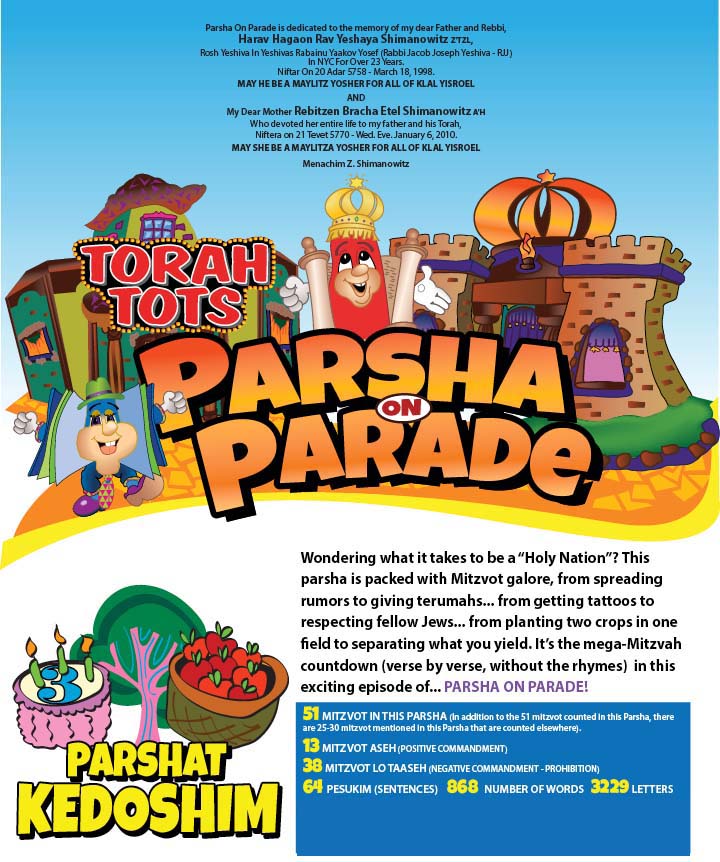
NUMBER OF MITZVOT: 51
13 MITZVOT ASEH (POSITIVE COMMANDMENT)
38 MITZVOT LO TAASEH (NEGATIVE COMMANDMENT - PROHIBITION)
(In addition to the 51 mitzvot counted in this Parsha, there are 25-30 mitzvot mentioned in this Parsha that are counted elsewhere).
NUMBER OF PESUKIM (SENTENCES): 64
NUMBER OF WORDS: 868
NUMBER OF LETTERS: 3229
HAFTORA: (Additional portion, from Prophets, which is read after the Parsha)
Amos 9:7 - 15 (Ashkenazim);
Yechezkel / Ezekiel 20:2 - 20 (Sepharadim)
פסח שני Pesach Sheni is Friday, 14 Iyar - May 8, 2009 This Shabbat we study Chapter 3 of Pirkei Avot - "Ethics of the Fathers."
|
פרשת קדושים
THE
PARSHA
|
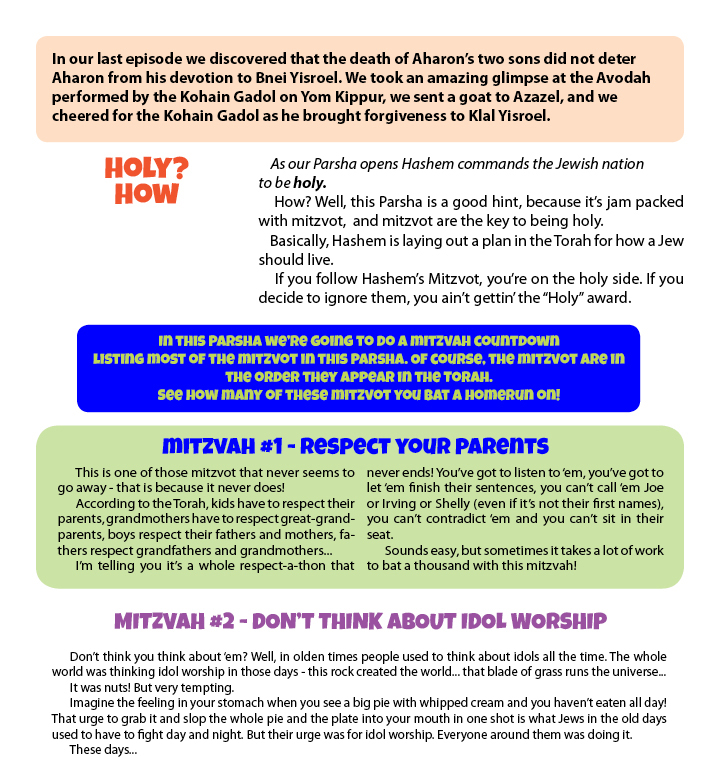
In our
last episode we discovered that the death of Aharon's two sons did
not deter Aharon from his devotion to Bnei Yisroel. We took
an amazing glimpse at the Avodah performed by the Kohain
Gadol on Yom Kippur, we sent a goat to Azazel,
and we cheered for the Kohain Gadol as he brought forgiveness
to Klal Yisroel.
|
HOLY? HOW?
|
As our Parsha opens
Hashem commands the Jewish nation to be holy.
How? Well, this Parsha
is a good hint, because it's jam packed with mitzvot, and
mitzvot are the key to being holy.
Basically, Hashem is laying out a plan in the Torah
for how a Jew should live.
If you follow Hashem's Mitzvot, you're on the holy side.
If you decide to ignore them, you ain't gettin' the "Holy" award.
In this Parsha we're going to do a mitzvah countdown listing most of the mitzvot in this Parsha.
Of course, the mitzvot are in the order they appear in the Torah.
See how many of these mitzvot you bat a homerun on!
|
|
MITZVAH #1
RESPECT YOUR PARENTS
|
This is
one of those mitzvot that never seems to go away - that
is because it never does!
According to the
Torah, kids have to respect their parents, grandmothers
have to respect great-grandparents, boys respect their fathers
and mothers, fathers respect grandfathers and grandmothers...
I'm telling you
it's a whole respect-a-thon that never ends! You've got to listen
to 'em, you've got to let 'em finish their sentences, you can't
call 'em Joe or Irving or Shelly (even if it's not their first
names), you can't contradict 'em and you can't sit in their seat.
Sounds easy, but
sometimes it takes a lot of work to bat a thousand with this mitzvah!
|
|
MITZVAH #2
DON'T THINK ABOUT IDOL WORSHIP
|
Don't think you think about
'em? Well, in olden times people used to think about idols all the
time. The whole world was thinking idol worship in those days -
this rock created the world... that blade of grass runs the universe...
It was nuts! But very tempting.
Imagine the feeling in your stomach when you see a big pie with
whipped cream and you haven't eaten all day! That urge to grab
it and slop the whole pie and the plate into your mouth in one
shot is what Jews in the old days used to have to fight day and
night. But their urge was for idol worship. Everyone around them
was doing it.
These days...
|
|
MITZVAH #3
LEAVE PART OF YOUR HARVEST FOR THE POOR
|
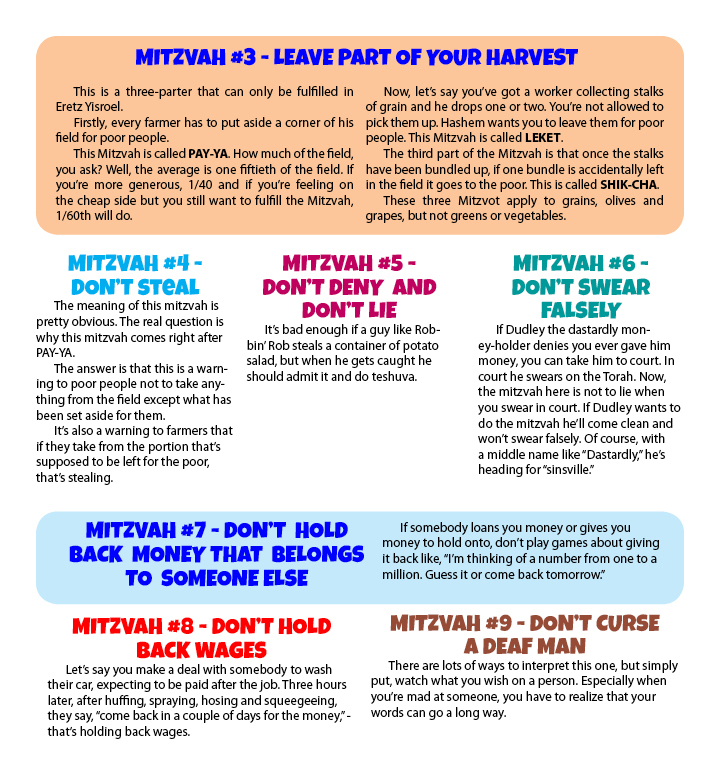
This
is a three-parter that can only be fulfilled in Eretz Yisroel.
Firstly, every farmer has to put aside a corner of his field
for poor people.
This Mitzvah is called PAY-YA. How much of the
field, you ask? Well, the average is one fiftieth of the field.
If you're more generous, 1/40 and if you're feeling on the cheap
side but you still want to fulfill the Mitzvah, 1/60th
will do.
Now, let's say you've got a worker collecting stalks of grain
and he drops one or two. You're not allowed to pick them up. Hashem
wants you to leave them for poor people. This Mitzvah
is called LEKET.
The third part of the Mitzvah is that once the stalks
have been bundled up, if one bundle is accidentally left in the
field it goes to the poor. This is called SHIK-CHA.
These three Mitzvot apply to grains, olives and grapes,
but not greens or vegetables.
|
|
MITZVAH #4
DON'T STEAL
|
The meaning of this mitzvah is pretty obvious. The real
question is why this mitzvah comes right after PAY-YA. The answer is that this is a warning to poor people not to take anything from the field except what has been
set aside for them.
It's also a warning to farmers that if they take from the portion that's supposed to
be left for the poor, that's stealing.
|
|
MITZVAH #5
DON'T DENY AND DON'T LIE
|
It's bad enough if a guy like
Robbin' Rob steals a container of potato salad, but when he gets
caught he should admit it and do teshuva.
|
|
MITZVAH #6
DON'T SWEAR FALSELY
|
If Dudley the dastardly money-holder denies you ever gave him
money, you can take him to court. In court he swears on the Torah. Now,
the mitzvah here is not to lie when you swear in court. If Dudley wants to do the
mitzvah he'll come clean and won't swear falsely. Of course, with a middle name
like "Dastardly," he's heading for "sinsville."
|
|
MITZVAH #7
DON'T HOLD BACK MONEY THAT BELONGS TO SOMEONE ELSE
|
If somebody loans you money or gives you money to hold onto, don't
play games about giving it back like, "I'm thinking of a number from
one to a million. Guess it or come back tomorrow."
|
|
MITZVAH #8
DON'T HOLD BACK WAGES
|
Let's say you make a deal with somebody to wash their car, expecting
to be paid after the job. Three hours later, after huffing, spraying, hosing
and squeegeeing, they say, "come back in a couple of days for
the money," - that's holding back wages.
|
|
MITZVAH #9
DON'T CURSE A DEAF MAN
|
There are lots of ways to interpret this one, but simply put,
watch what you wish on a person. Especially when you're mad at someone, you have
to realize that your words can go a long way.
|
|
MITZVAH #10
DON'T TRIP A BLIND MAN BY PUTTING SOMETHING IN HIS
WAY
|
The simple explanation is this: If you are leading a blind guy
down the street, don't purposely make him hit a wall.
The real meaning of this mitzvah is don't give wrong advice
to trick somebody. For example, Reuven asks you what time the bus is coming. You know it's coming at 2, but you tell Reuven 3. Guess what? You've just "tripped
a blind man."
|
|
MITZVAH #11
JUDGE OTHERS FAVORABLY
|
This is a real tough one!
Everytime you meet up with someone or pass by someone, you're bound to make some kind of judgment about him.
Hashem wants us to think of that person in a good way. Sometimes a guy's in a bad mood or has something on his mind that can make him do things he wouldn't
usually do. Give him the benefit of the doubt.
|
|
MITZVAH #12
DON'T SPREAD STORIES ABOUT OTHERS!
|
This is a two-parter. Firstly, we're not allowed to spread Lashon
Horah. Lashon Horah is gossip that is TRUE but not nice.
Secondly, if Shimon says something about Reuven, don't repeat
it back to Reuven. This leads to tons of trouble. You're better off just
keeping it to yourself.
|
|
MITZVAH #13
DON'T HATE ANOTHER JEW
|
All Jews are brothers
when they keep the mitzvot of Hashem. It is important
to give each other respect and stick together. We always hope that
other Jews will put their best foot forward and that we will all
get along.
|
|
MITZVAH #14
SET 'EM STRAIGHT
|
Since all Jews are brothers, we shouldn't be embarrassed to correct
someone who doesn't know how to do a mitzvah properly:
"Excuse me, Mechel, but you can't use an eggplant for besomim."
"Please allow me to fix your Tefillin - you have
it on your leg, but it goes on your arm."
"Shmuel, I couldn't help but to notice that you made kiddush
on pickle juice and Hamotzi on a banana."
|
|
MITZVAH #15
DON'T TAKE REVENGE
|
Let's say that Dovie takes away your baseball during a game and
ruins the game. Now, on Friday night at the Shabbat table you get an idea:
"why not steal his matza ball from his soup! That'll teach him!"
-- Sorry, buddy, but that's called "revenge" and you're not allowed to do
that!
|
|
MITZVAH #16
DON'T REMEMBER THE EVIL A FELLOW JEW DID
|
Remember the matza ball? Better give him an extra one because
you forgot all about the baseball incident. Hashem commands us to forgive
and forget about mean things people do to us. Why? Well, one reason is that we
really don't want Hashem keeping track of the bad things that we do.
This is one way to wipe the slate clean.
This is a tough mitzvah but we've got to do our best with
it.
|
|
MITZVAH #17
LOVE YOUR FELLOW JEW AS YOURSELF
|
This is a biggie!
As a matter of fact, some Sages say that you can learn
the whole Torah just from this one mitzvah! Hashem
wants all Jews to get along. That means we must try to understand
and help each other.
When Jews get along, Hashem is closer to us. When we don't, terrible
things happen! The Bait Hamikdash was destroyed, because Jews couldn't
get along with each other, so you see how much weight Hashem places on Jews
getting along.
|
MITZVAH #18 DON'T MIX TWO TYPES OF PLANTS IN THE SAME FIELD
|
This one is for farmers in Eretz Yisroel. You can't plant two different foods
together in one field. For example, you can't plant grapes and tomatoes or
wheat and cucumbers together in one field. There are all kinds of rules about
how far apart plants need to be.
Even outside of Eretz Yisroel you can't graft one plant
to another to make a new kind of fruit, like taking a watermelon and mix it with a
cucumber to make a water-pickle.
|
|
MITZVAH #19
DON'T WEAR SHATNEZ
|
Here's one that
come up every time we buy clothes. We're not allowed to mix the
two materials, WOOL and LINEN. This mixture is called Shatnez.
This is tough because only a trained shatnez tester can really tell if
there are a couple of linen threads mixed into wool fibers, or a button is
sown on a linen garment with wool threads.
|
|
MITZVAH #20
THE LAW OF ORLAH
|
Here's
a law about trees that applies to Jewish farmers all over the world.
If you plant a tree, you can't eat from its fruit for the first
three years. The fruit is ORLAH (forbidden).
However, outside Eretz Yisroel, if we do not know whether
the fruit we are buying is ORLAH, we may eat the fruit.
It is only forbidden if we know for sure that the fruit is
ORLAH
The fruit of the fourth year has to be taken to Yerushalayim
and eaten there.
This only applies, however, to the times when the Bait Hamikdash
is standing.
These days, we exchange the fruits for a coin.
|
|
MITZVAH #21
WE CAN'T EAT OVER BLOOD
|
There are two explanations for
this mitzvah.
The first has to do with eating the meat of a Korban before
the blood has been sprinkled on the mizbayach (Altar).
Another explanation is that a person over bar-mitzvah
age must daven Shacharit (pray the morning prayers) before
eating breakfast.
|
|
MITZVAH #22
DON'T BE SUPERSTITIOUS
|
Don't walk under a ladder because it's unlucky? Not anymore,
because that's being superstitious and being superstitious is
against the Torah. Don't walk under a ladder because it
might fall on your head. Thats OK.
Why don't we believe in lucky horseshoes, unlucky black cats?
Because we put all of our faith in Hashem.
Hashem guides our lives and protects the Jewish nation.
|
|
MITZVAH #23
DON'T CUT OFF YOUR PAYOT
|
Payot are the sideburns on each side of the face. Hashem
tells us not to cut them above our cheek bones, alongside our ears. Some people are
really careful and let their payot grow long and twirly!
One reason for payot is to look and act different from
the other nations.
|
|
MITZVAH #24
DON'T TATTOO YOUR BODY
|
I guess those dreams of having "MOM" tattooed on your
arm will have to go!
Hashem wants us to keep our bodies clean and in good condition.
We are forbidden to make any permanent markings on our bodies.
|
|
MITZVAH #25
SHOW RESPECT FOR THE BAIT HAMIKDASH
|
When someone steps
on the Har Habayit (Temple Mount) in Yerushalayim,
he must take it very seriously because this is the place where Hashem
has chosen to rest His Shechina. We must show great respect.
Even though the Bait Hamikdash no longer stands, this mitzvah applies
to our shuls (synagogues). We must show great respect in a shul. That means keeping silent
and not running around or being silly.
|
|
MITZVAH #26
DON'T PERFORM THE MAGIC OF OV AND YIDONI
|
In the times of the Torah, nations used to rely on magic. There
are a lot of ways to make things in this world happen through magic and witchcraft.
But Hashem forbids us to use such sorcery. Here are two popular
trickeries in particular that Hashem forbids:
- Ba'al ov - this guy had a neat trick. He threw his voice
and made it sound like the voice was coming from somewhere else. Then he made
dead bodies rise and tricked people into thinking that these bodies were talking.
- Yidoni - This guy put a bone of a certain animal in his
mouth and was able to make the bone talk! Then he would fall on his face and
predict the future!
|
|
MITZVAH #27
SHOW HONOR
FOR THE
ELDERLY
|
When a Jew hits
70, he or she automatically commands respect. Even if the person
is not a scholar. The fact that Hashem has allowed them to
live so long means that they have experienced the ways of the world,
and deserve our respect.
|
|
MITZVAH #28
HONOR OUR TORAH SCHOLARS
|
A Torah
scholar at any age is called a Zakain (Elder). That's because
he is as wise as an old man. We must show great respect for a scholar.
When he walks into the room we must stand up. We must also be careful
not to contradict or interrupt our rebbes (teachers).
|
|
MITZVAH #29
DON'T CHEAT WITH WEIGHTS AND MEASURES
|
Ever see the scales they use in a fruit store or the flat scales
in a meat store? It is very easy to readjust these scales so that they don't
measure properly.
When a Jewish store-keeper buys a scale he must make sure that
the numbers are accurate so that he won't cheat any of his customers.
Wow! That's a lotta mitzvot. But now we've got the key
to being holy... Keep the mitzvot of Hashem and Hashem will protect
you from harm.
Tune in next week when we check out the Shalosh Regalim
in the next exciting episode of:
|