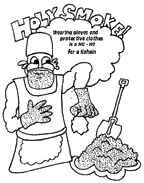
You might think that
a Kohain would turn in his priestly garments for a pair
of jeans and a tee-shirt when it comes to such lowly temple tasks
like removing the ashes from the Mizbayach. But that's
not the case.
As a matter
of fact, the Torah especially mentions two priestly garments, the pants
and the tunic (apron) to make sure that there's no mistaking the matter.
Even though we're talking about a mere spoonful of ashes, some
neat-freak Kohain might get the idea that he could spare his tunic and
pants from the cleaners if he just changed into a pair of overalls or shifts
them off to the side. But the Torah teaches us that a little stain in
Hashem's name is OK. In other words, there are no lowly jobs
in the Mishkan, - it's all part of the service to Hashem.
Indeed, every Jew must humble himself in the service of Hashem. Even
King David was known to skip and dance before the holy Aron
as it made its way through the streets of Yerushalayim.
Similarly, the great sages, Hillel and Rabban Gamliel, let down
their guard during Simchat Bait Hashoeva (celebration
of the drawing of water) on Sukkot, in the Bait
Hamikdash and danced wildly during the celebrations.
You can also take a lesson from Shevet Levi: If anyone
had a reason to complain about lowly jobs, it was the Leviyim.
This shevet, which had the highest status in all of
Bnei Yisroel, was reduced to a team of 'shleppers',
packing and carrying the kaylim of the Mishkan
through the desert. This teaches a lesson - that one must overlook
one's own honor and status in order to honor Hashem.
It also teaches that all jobs in the Mishkan are of
equal importance to Hashem.
The Talmud tells a story of one particular Kohain Gadol, Yissachar of
K'far Barkai, who decided that his hands were too sensitive to touch the
blood and meat of the Korbanot. He insisted upon wearing a pair of
silk gloves whenever he performed the Avoda in the Bait Hamikdash. This silky
smooth style, however, did not sit well with the heavenly court which
decreed that his hands be cut off as a punishment for his
degrading delinquency.
Here's how that decree panned out: One day, the Hasmonean king and queen
got into a royal dispute. The king insisted that goat meat was the best
meat around. The queen insisted that lamb is number one. There was only
one way to settle the dispute - ask the Kohain Gadol. He got to taste all
the meat left over from the daily sacrifices. He'd surely know which
meat was superior.
So they sent for Yissachar the Kohain Gadol. When
Yissachar heard the nature of the argument, he waved his hand
in the air as if to say, "What is this silly question?" He replied,
"Lamb, of course, is the better meat. That's why the Torah
commands us to sacrifice the lamb twice a day."
Well, the king was willing to accept a defeat over the dispute about
meat, but was taken aback by the insubordinate waving gesture. How dare
the Kohain Gadol brush off a royal request as unimportant! The king
decreed that Yissachar's right hand be chopped off.
Just as they were
about to carry out the punishment, Yissachar bribed the guard to chop
off his left hand instead of his right. After his left hand had been cut off, the king got wind of the
waver's bribe, and in a rage ordered the Kohain's right hand to be cut off as well. Now
Yissachar had no hands and thus the decree of the heavenly court was
carried out by the Hasmonean king.
This story teaches us that in the eyes of royalty, even the smallest
request, insignificant as it may seem, is of great consequence. If a
hand gesture by the Kohain Gadol could be so severely punished, imagine
the honor that we must bestow upon even the most seemingly insignificant
commandments that Hashem places before us.
But don't throw away the old clothes yet. There is, however, one situation where the Kohain must switch clothes to serve Hashem.
The Torah tells us that when the pile of ashes gets so big that it covers the Mizbayach completely, and there is no more room for Karbanot, the ashes must be gathered up and transported out of the three camps (or outside Yerushalayim, in the case of the Bait Hamikdash). In this case, since the Kohain will be moving a great deal of ashes, he would be very likely to soil his good garments. Therefore, a Kohain must change out of his regular garments and change into older, more worn priestly garments to do the dirty work. Once the dirty work is done, he should change into his clean garments to perform the other services.
As the Sages teach us: It is not proper for a servant to serve his master in the same stained clothes that he wears in the kitchen sweating over a hot stove. When he serves his master he must put on clean clothes.
From this we also learn the importance of changing into our best clothing in honor of the Shabbat, after having worn something else while performing the menial tasks in preparation for this holy day. This applies especially to women, who generally do not attend the synagogue on Friday evening.