|
WHAT'S
THE STORY?
39
MELACHOT
GETTING
READY FOR SHABBAT
LIGHTING
SHABBAT CANDLES
SHABBAT
MEALS
FRIDAY
NIGHT
THE
SHABBAT DAY
SEUDAH
SHLISHIT
HAVDALAH
MELAVE
MALKA
SPECIAL
SHABBATOT
GLOSSARY
FUN
& GAMES
SHABBAT
GREETING CARDS
THE INTERACTIVE CD
ZEMIROT
|

|
|
|
WHAT'S
THE STORY?
"I have a precious
gift in my treasury," said HASHEM to Moshe; 'Shabbat'
is its name; go and tell Israel I wish to present it to them."
(Tractate Shabbat 10b) |
REFERENCES |
A HOLY DAY
"Shabbos"
or "Shabbat"
"Shabbos" - the Ashkenazic pronunciation, or
"Shabbat" - the Sephardic pronunciation, either
way it is the Hebrew word for the seventh day of the week; known
in English as the "Sabbath." The root of the word means
"to rest or desist." Shabbat, the Divinely appointed
day of rest, begins (18 minutes) before sundown on Friday and
ends Saturday night when three stars appear in the sky. (About
45 minutes to 1 hour after sundown.)
The very first thing in all
of the Torah to be called holy is Shabbat.
The Torah states (Bereishit / Genesis 2:1-3):
"By the seventh day, G-d completed His work which He had
done... G-d blessed the seventh day, and He made it holy..."
What is the holy Shabbat?
We could spend hours and write pages of descriptions, yet
we could not fully explain Shabbat. Shabbat has
to be experienced to understand it.
Lets go back to the creation of the world.
For six days Hashem created the heavens and the earth.
On the seventh He rested. That's what Shabbat is all about.
Six days a week we go about our lives working and playing and
doing what it takes to live in this world. But by the time the
sun sets on Friday night, the hustle and bustle of the world is
put behind us and the Shabbat celebration surrounds us.
On Shabbat we don't perform any work.
Instead, we proclaim that Hashem is the master of all creation.
Observing Shabbat is one of the Aseret Hadibrot
- Ten Commandments. Hashem simultaneously commanded that
the Jews "remember" (Zachor)
and "safeguard" (Shamor)
the Shabbat.
ZACHOR (remember) is the Commandment
to observe the positive precepts of our Shabbat.
We fulfill the "remembrance" of Shabbat through
positive actions which honor Shabbat:
· Reciting Kiddush (a special prayer over wine before
the first and second Sabbath meals);
· Eating three festive meals;
· Wearing our nicest clothes;
· Saying special Shabbat Tefillot (prayers);
· Laining (reading) the Parsha (Torah portion)
of the week;
· Singing Zemirot (Shabbat Table Songs);
etc.
SHAMOR (safeguard) is the Commandment
to avoid violation of the negative precepts of our Shabbat.
We fulfill the "safeguarding" aspects of Shabbat
by refraining from 39 categories of "melacha"
(creative activity), which the Jews had to perform on weekdays
in order to build the Mishkan. We also refrain from other
activities, which may be halachically permitted, but are
not fitting or appropriate on this special day.
There are many customs and commandments regarding the observance
of Shabbat. Its observance is referred to as Shmirat
Shabbat. One who traditionally observes Shabbat is
called a Shomer Shabbat.
|
|
|
REFERENCES
|
The observance of Shabbat
is mentioned a number of times in the Torah, most notably
as the fourth of the Aseret Hadibrot - Ten Commandments
(Shmot / Exodus 20:8-11 and Devarim / Deuteronomy
5:12-15). Here are some references:
"ZACHOR"
"Remember the Sabbath day to sanctify it. Six days shall
you work and accomplish all your work; but the seventh day is
Sabbath to HASHEM, your G-d; you shall not do any work -
you, your son, your daughter, your slave, your maidservant, your
animal, and your convert within your gates - for in six
days HASHEM made the heavens and the earth, the sea and all that
is in them, and he rested on the seventh day. Therefore, HASHEM
blessed the Sabbath day and sanctified it."
(Shmot / Exodus 20:8-11)
"....However, you must observe My Sabbaths. for it is
a sign between Me and you for your generations, to know that I
am HASHEM, Who makes you holy. You shall observe the Sabbath,
for it is holy to you; its desecrators shall be put to death,
for whoever does work on it, that soul shall be cut off from among
its people. For six days work may be done and the seventh day
is a day of complete rest, it is sacred to HASHEM; whoever does
work on the Sabbath day shall be put to death.
The Children of Israel shall observe the Sabbath, to make the
Sabbath an eternal covenant for their generations. Between Me
and the Children of Israel it is a sign forever that in a six
day period HASHEM made heaven and earth, and on the seventh day
He rested and was refreshed."
(Shmot / Exodus 31:12-17)
"For six days labor may be done, and the seventh day is
a day of complete rest, a holy convocation, you shall not do any
work; it is a Sabbath for HASHEM in all your dwelling places."
(Vayikra / Leviticus 23:3)
"SHAMOR"
"Safeguard the Sabbath day to sanctify it, as HASHEM,
your G-d, has commanded you. Six days shall you
labor and accomplish all your work; but the seventh day is Sabbath
to HASHEM, your G-d; you shall not do any work
- you, your son, your daughter, your slave, your maidservant,
your ox, your donkey, and your every animal, and your convert
within your gates, in order that your slave and your maidservant
may rest like you. And you shall remember that you were
a slave in the land of Egypt, and HASHEM, your G-d, has taken
you out from there with a strong hand and an outstretched arm;
Therefore HASHEM, your G-d, has commanded you to make the Sabbath
day."
(Devarim / Deuteronomy 5:12-15)
|
|
|
back
to top
next topic |
RETURN
TO MAIN SHABBAT PAGE |
|
|
|
39 MELACHOT
MUKTZAH
|
MELACHA
PLEASE
NOTE: This is just a VERY BASIC introduction. There are many complex
laws regarding Shabbat, and this is not the forum for decisions
regarding what is or is not allowed on Shabbat. This is
just to give the reader a flavor of the intricate halachot
involved. A competent halachic authority should be consulted with
any questions.
Melacha (plural
"melachot").
1. Melacha
refers to the 39 categories of activity that are forbidden on
Shabbat. Melacha, is not "work." At least
not the English definition of the word "work." You may
not carry a needle out into the street on Shabbat, yet
you may drag a heavy sofa across the room. So what Melacha
is forbidden on Shabbat?
The 39 categories
of activity that are forbidden on Shabbat, are all labors
that have something in common - they are creative activities that
exercise control over one's environment.
Specifically, the
Talmud derives these 39 categories from the fact that the Torah
juxtaposes the commandment to cease work on Shabbat in
Shmot Parshat Vayakheil, with its detailed instructions
on how to build the Mishkan*,
and
the preparation of its components, as described in Shmot
/ Exodus 31 and 35.
*[Mishkan
- Tabernacle; the portable, temporary version of the Holy Temple
that the Jews carried throughout the forty years in the desert
into Eretz Yisroel (the land of Israel), until they built
the Beit HaMikdash]
This is to teach us, explains the Talmud (Shabbat 49b),
which activities constitute melacha: any creative act that
was part of the mishkan's construction represents a category
of work forbidden on Shabbat. These categories are forbidden
by the Torah.
2. Toldot -
Work which is different from that done in the Mishkan,
but which achieves the same result. These types of melacha
are also prohibited by the Torah.
3. Rabbinic Decrees
- There are a number of additional activities that are forbidden
by the Rabbis. There are several categories of decrees that prohibit:
a. Activities that
might lead directly to the violation of a Torah prohibition.
b. Use of items
not designated for Shabbat use (muktzah).
c. Activities that
might lead one to think that a prohibited activity is permissible
(Ma'arit Ayin - The appearance of the eye).
d. Activities that
are not appropriate for Shabbat, even though they are technically
permissible (Uvda D'Chol - [resembles] weekday activity).
The Navi Yeshayahu (Prophet Isaiah (58:13-14) recorded
a prohibition against speaking of business and against weekday-oriented
activities. See below for many more examples.
|
THE 39 MELACHOT
Lamed-Tet Melachot
Here is the list of the 39 Melachot
(main activities) prohibited on the Shabbat:
For more details about the 39 Melachot, click here.
1. Zoreah - Sowing
(seeding)
2. Choresh - Plowing
3. Kotzair
- Reaping (cutting)
4. M'amair - Gathering
(bundling sheaves)
5. Dush - Threshing
6. Zoreh - Winnowing
7. Borer - Sorting (selecting, separating)
8. Tochain - Grinding
9. Miraked - Sifting
10. Lush - Kneading
11. Ofeh / (Bishul) - Baking/cooking
12. Gozez - Shearing
13. Melabain
- Whitening (bleaching)
14. Menafetz
- Disentangling, Combing
15. Tzovayah
- Dyeing
16. Toveh - Spinning
17. Maisach - Mounting the warp
(stretching threads onto loom)
18. Oseh Beit Batai Neirin - Setting
two heddles (preparing to weave)
19. Oraig - Weaving
20. Potzai'ah -
Separating (removing) threads (Unweaving)
21. Koshair - Tying a knot
22. Matir - Untying a knot
23. Tofair - Sewing
24. Ko'reah - Tearing (unsewing - ripping)
25. Tzud - Trapping
26. Shochet - Slaughtering
(Killing)
27. Mafshit - Skinning
28. M'abaid - Salting/tanning process
[1]
29. Mesharteit - Tracing
(scratching) lines
30. Memacheik - Smoothing / scraping
31. Mechateich - Cutting (to shape)
32. Kotaiv -
Writing two or more letters
33. Mochaik - Erasing two or more letters
34. Boneh - Building
35. Soiser - Demolishing
36. Mechabeh
- Extinguishing (putting out a flame)
37. Ma'avir - Kindling
(making a fire)
38. Makeh B'Patish - Striking
the final blow (Finishing an object)
39. Hotza'ah - Transferring (transporting) from
domain to domain (carrying)
[1] The list of Melachot in the Talmud (Tractate
Shabbat 7:2) includes salting hides and tanning as separate
Melachot. The Talmud (Tractate Shabbat 75b)
states that these two are really the same Melacha,
and amends the Mishna by inserting tracing lines,
as the twenty-ninth Melacha.
These 39 Melachot are divided into six (6) groups:
Group I = Numbers 1-11
Group II = Numbers 12-24
Group III = Numbers 25-31
Group IV = Numbers 32-33
Group V = Numbers 34-35
Group VI = Numbers 36-39
Group V = Numbers 34-35
Group VI = Numbers 36-39
Group I is connected to the field work.
Group II is connected to the making material curtains
Group III is connected to the making of leather curtains
Group IV is connected to the Krushim (beams of the
Mishkan)
Group V is connected to the putting the walls of the Mishkan
up and down
Group VI is connected to the final touches of the Mishkan
|
The 39 melachot
are not so much activities as categories of activity. For example,
while "sorting" usually refers exclusively to the separation
of chaff from grain, it refers in the Talmudic sense to any separation
of intermixed materials which renders edible that which was inedible.
Thus, picking small bones from fish falls under this category.
(Gefilte fish is the traditional Ashkenazi solution
to this problem.)
In the event that
a human life is in danger, a Jew is not only allowed, but required,
to violate any Shabbat law which stands in the way of saving
that life.
Some Mitzvot
we do not perform on Shabbat
1. We do not put
on Tefillin
2. We do not blow shofar on Shabbat Rosh Hashana
3. We do not use the Etrog and Lulav on Shabbat
Sukkot
4. We do not read the Megillah on Shabbat Purim
Sample
Melachot - Activities Forbidden on Shabbat
Watering Plants,
Squeezing Fruits,
Playing or carrying musical instruments,
It is forbidden to read bills or secular papers.
It is forbidden:
To Cook,
To Write,
To light candles,
To Mince (litchon),
To Pick.
Muktzah:
PLEASE
NOTE: This is just a VERY BASIC introduction. There are many complex
laws regarding Muktzah on Shabbat, and this is not
the forum for decisions regarding what is or is not allowed on
Shabbat. This is just to give the reader a flavor of the
intricate halachot involved. A competent halachic authority
should be consulted with any questions.
(Lit. 'set apart.')
An object forbidden to be used or carried on the Shabbat
and Festivals because of its not being fit or meant for use on
that day. One must avoid doing anything on Shabbat that
could lead to work - i.e. carrying money. As a result, anything
that cannot be used, money, a hammer, etc., also cannot be handled.
The broad term for such items is "Muktzah." This
includes objects like tools, wallets, money, matches, cigars,
electronic devices, writing instruments, tickets, candlesticks,
musical instruments, and so forth.
The main categories
of muktzah are:
Tools whose primary
use is for work prohibited on Shabbat - for example, a
hammer.
Muktzah because
of (concern about) monetary loss.
This covers expensive items not ordinarily handled at all and
items which are only used for work that is not done on Shabbat
-- for example, the specialized knife used for kosher slaughtering.
Muktzah in
and of itself.
Objects that have essentially no use at all -- for example, garbage,
broken utensils.
Muktzah because
of prohibition.
Damaged objects which one might be tempted to repair on Shabbat
(thereby doing prohibited work) in order to use them -- for example,
a chair with a broken leg.
Muktzah because
of a mitzvah.
Objects whose only purpose is for a mitzvah - for example,
the components of a Sukkah.
Nolad - Newborn
items.
Objects that did not exist before Shabbat -- for example,
an egg laid
on Shabbat.
(Source:
R' Simcha Bunem Cohen, Muktzah: A Practical Guide, ch.
1)
The basic rule with all these categories of objects is not to
move or touch them, but the specific guidelines and exceptions
vary with each category. The overall effect of observing these
rules is to enhance one's detachment, on Shabbat, from
the everyday world of activity.
Forbidden
Activities
We refrain from other activities,
which may be halachically permitted, but are not fitting
or appropriate on this special day. The following activities are
in accord with Jewish law but are not mandated:
· Riding bicycles
or skateboards, roller skating
· Carrying pocketbooks.
· Playing ball in
the street or otherwise in public view (within an Eruv)
is also included. Children under the age of Bar/Bat
Mitzvah may play ball in their yards; it is up to parents
to weigh how their children's attitude to Shabbat is affected
by playing these games.
· Taking a nature
walk or hike;
· Reading magazines,
newspapers or books.
Permitted
activities
The following activities
are encouraged on Shabbat:
· Visiting family
and friends (within walking distance of home and synagogue);
· Spending Shabbat
together with your own immediate family;
· Synagogue attendance;
· Hosting family
and friends to sleep over for Shabbat;
· Having family
and friends for Shabbat meals;
· Singing zemirot,
etc. (commonly done during the Shabbat meals);
· Reading, studying
and discussing Torah and commentary, Mishnah and
Talmud, halacha and responsa and Midrash.
|
|
|
| back
to top
next topic
|
RETURN
TO MAIN SHABBAT PAGE |
|
|
|
GETTING
READY FOR
SHABBAT
"And
it shall be on the sixth day (of the week) that they shall
prepare that which they shall bring home."
(Shmot / Exodus 16:5) |
Taking
Challah
Mikveh,
Shabbat Outfits
Shnayim
Mikrah Ve'echod Targum
Food
for the Poor
Tzedakah
Set
Shabbat Table
|
Shabbat is the
highlight of the Jewish week, eagerly awaited with great anticipation.
The countdown to Shabbat begins with the days of the week.
Sunday is not called Sunday, Monday is not called Monday, etc.
Rather, the days of the week are reminders of Shabbat whenever
we mention them. They are named in Hebrew in relation to the Shabbat:
Sunday is called 'the first day to Shabbat,' Monday is
called 'the second day to Shabbat,' etc." (For
more about this, see Ramban, Shmot 12,2 and Bamidbar
20,8).
Shopping - Provisions
for Shabbat
Everyone looks forward to Shabbat.
Business and social arrangements are made in such a way that they
will not interfere with the Shabbat. Shabbat is welcomed
with forethought and preparation. Little luxuries bought during
the week are stored up for the Shabbat. The careful planning
continues until just before Shabbat begins. It is a Mitzvah
for every individual to personally prepare something each week
in honor of Shabbat. In fact, the Talmud relates
many stories of Chachomim
(Sages) who made sure to prepare several things before Shabbat
by themselves, even though they may have had servants and maids
to do it.
It is even recommended that
one should arise early Friday morning and immediately begin Shabbat
preparations so that they will be ready in time for Shabbat.
One may even learn a little less Torah on Friday, in order
to spend time preparing for Shabbat.
It customary to spend more
in honor of Shabbat, because the Talmud tells us,
(Tractate Beitza 16a), that whatever you earn during the
year is pre-designated on Rosh
Hashana and Yom
Kippur, except what you spend to honor the Shabbat,
holidays and money that is used for Torah education of
children. These expenses are up to the individual; the less one
spends, the less one gets in return. But the more one spends on
these three categories, the more G-d gives in return. Thus, spending
money to honor Shabbat is, in fact, a great investment
for which G-d repays us much more in return.
Here are some ideas to consider
when preparing for the Shabbat:
· Invite guests to join
you for Shabbat dinner or lunch, - especially the needy.
· Use something new or wear new clothing for the first
time on Shabbat.
· Plan a special menu for Shabbat meals.
· Prepare for a Shabbat/Torah conversation at the
table.
Taking
Challah / Hafroshat Challah
Many women bake their own Challah
before Shabbat, so that they can do the special Mitzvah
of removing a small piece of dough called "Challah."
A token amount of dough (the size of an olive) is removed from
the dough and thrown into the oven fires while reciting a specific
bracha / blessing. This reflects the portion given to Kohanim
in the times of the Beit Hamikdash. (Bamidbar /
Numbers 15:17-21). Nowadays, since there are no longer officiating
Kohanim, the challah is removed and burned. This
is one of the three special mitzvot for women. The Shabbat
bread that we call “challah” is so named as a
reminder of this mitzvah. For specific rules, click
here.
Mikveh,
Shabbat Outfits
We bathe, put on clean clothes
and get ready to welcome the Sabbath. Many men immerse in a mikveh
(spiritually purifying bath) Erev Shabbat (Friday afternoon)
to honor the Shabbat.
Reading
the Parsha twice and Targum once on Erev Shabbat.
In conjunction with the public
reading of the Parshat Hashavuah - (the weekly Torah
portion), our Sages require that every individual study it
on his own and be familiar with its basic meaning. (Talmud,
Tractate Berachot 8a, See O.C. 285). To achieve this level
of mastery, they instituted a three-tiered review of the parsha:
Each verse of the text itself must be read twice, to master the
hebrew, followed by the Aramaic translation known as Targum
Onkelos' so that it is understood. The name of this mitzvah
is "Shnayim Mikrah Ve'echod Targum - twice the Scripture
and once the translation of Onkelos."
Food
for the Poor
We must not forget those less
fortunate than ourselves. In many towns and cities across the
country and in Eretz Yisroel, there are organizations that
provide food and Shabbat necessities to the needy before
Shabbat. Here in Brooklyn, we have a worthy organization
called "Tomche Shabbos," which delivers food
anonymously to sustain poor families through the Shabbat
and Holidays. In Eretz Yisroel, Yad
Eliezer is one of the foremost organizations, servicing
the poor and the needy.
Tzedakah - Charity
"Kol Yisrael arevim zeh bazeh." "All Israel is responsible
for one another." (Talmud Shavuot 39a).
It is customary to give tzedakah by putting a few
coins in a tzedakah box before lighting the Shabbat
candles. Many families place a special tzedakah box next
to the Shabbat candle holders to remind them to perform
this mitzvah. Encourage even the youngest child to contribute
a coin or two! Of course, don't forget to remove the tzedakah
box from the table before lighting the candles. (See
Muktzah below).
IDEAS
· Clear out all pockets and wallets of change before Shabbat
for tzedakah.
· Place coins in children's hands so they can get used to
giving tzedakah.
Set
Shabbat Table - Challah & Candles
· Tzedakah Box
· Candle Holders
· Shabbat Candles
· Objects on the Shabbat Table:
· Tablecloth, decorations, flowers, etc.
· Kiddish cup(s)
· Wine and/or grape juice
· Challot (two loaves or small
challah rolls, pita)
· Challah bread board or plate
with challah cover
· Challah knife
· Salt
· Handwashing cup and towel
· Siddur (Prayerbook) or Shabbat booklet that includes
the Kiddush, Shabbat Zemirot (songs) and Birchat HaMazon
(Grace After Meals).
"Reminder
List" for Friday Afternoon at Home
|
|
|
| back
to top
next topic
|
RETURN
TO MAIN SHABBAT PAGE |
|
|
LIGHTING
SHABBAT
CANDLES
| "If
you will observe the kindling of the Shabbat lights, I will
show you the lights of the redemption of the Jewish people."-
Yalkut Shimoni
"If you proclaim the Sabbath 'a delight'; the holy one of
Hashem 'honored'.... then you shall be granted delight with
Hashem..."
Isaiah 58:13-14
|
|
With a blessing on her lips
and a prayer in her heart, the Jewish woman ushers in Shabbat
HaMalkah, the Sabbath Queen, into her home.
For centuries, lighting the
Shabbat candles has been one of the most significant mitzvot
bestowed upon Jewish women. Tradition recounts the miracle of
our Matriarch, Sarah, whose Shabbat candles miraculously
burned from Shabbat to the following Shabbat. Our
Sages tell of our Matriarch, Rivkah, who lit the Shabbat
candles at the tender age of three.
The Holy Zohar teaches,
"A woman kindling the Shabbat candles, with joy in her
heart, brings peace on earth, health and happiness to her family,
and is blessed with children who brighten the world with the light
of tradition."
GUIDELINES
Women light candles every Friday
evening to mark the onset of Shabbat. In the beginning
of Sefer (the Book of) Bereishit / Genesis, the
Torah describes the six days of creation.
After each day the Torah says "And there was evening
and there was morning... "
This teaches us that the day begins from the previous evening.
Thus, Shabbat begins at sunset on Friday evening.
Candles
are lit about eighteen (18) minutes before sunset, since lighting
fire is forbidden on Shabbat. (This is the custom here
in the United States. In Yerushalayim, the custom is to
light candles 30-40 minutes before sunset.) By lighting the candles
ahead of the sunset and the new day, we eagerly borrow time from
the work week to extend the time of Shabbat as well as
ensuring that the candles will be lit properly before sunset.
For the correct candle lighting time in your area, consult the
list of candle lighting times at www.torahtots.com
or those provided by the Orthodox
Union.
It is a custom that the husband
or man of the house light the candles and blow them out before
Shabbat, so that the woman lighting the candles will have
an easier time lighting the candles.
The candles should be lit in
the dining area where the Shabbat dinner will take place
in order to honor the Shabbat by brightening the festive
meal. For safety reasons, make sure that the candles
are out of the reach of young children, away from curtains, and
are not exposed to an open window. The candles will not be moved
or touched after they are lit until Shabbat has ended because
they are muktzah, and during Shabbat,
one may not handle something that is muktzah.
It is customary for a married woman to light at least a pair of
candles as a reminder of both versions of the Fourth Commandment
in the Aseret Hadibrot (Ten Commandments - see above).
"Zachor - Remember" and "Shamor -
Observe" the Shabbat.
Many people light more than two (either with multiple candlesticks
or a candelabrum), some following the custom of lighting one candle
for each family member and others finding another symbolism in
a given number, such as seven (a Kabbalist custom). Single women
living alone traditionally light one candle. In some families,
as soon as a young girl can grasp the idea of Shabbat and
is able to recite the brachot / blessings (about three
years old), her mother teaches her to light her own candle. The
child lights her candle first, with her mother present in case
she needs assistance.
Although the mother of a family
or the women present customarily lights the candles, it is a household
requirement. A man living alone or away from home should light
the candles and say the blessing over them. Similarly, in the
absence of a woman or when a woman is too ill to do so, the man
present is required to light candles.
The time of lighting is considered
especially auspicious for praying to G-d for health and sustenance.
These prayers are readily acceptable because they are offered
during the performance of this great mitzvah.
COVERING THE
EYES
Have you ever wondered why
a woman lights the candles, then covers (closes) her eyes while
reciting the bracha / blessing on the Shabbat candles?
The reason is, that generally, Brachot / blessings are
recited before a Mitzvah is performed. (Case in point,
you say the bracha on the Matzah and then you eat
the Matzah; On Sukkot, you say the Bracha
"Al Netilat Lulav," and then shake the Lulav
and Etrog in six directions),
However, in the case of the Shabbat candles, once the woman
makes the bracha, she has already accepted the Shabbat
and its restrictions upon herself. In that case, she would no
longer be allowed to light the Shabbat candles.
Therefore, the woman lights the candles before saying the bracha,
while it is not yet Shabbat. But in order for her to fulfill
the concept of saying the bracha before the act, she does
so by not completing the mitzvah entirely until after saying
the bracha.
Here's how:
After lighting the candles,
she immediately covers her eyes. She then says the bracha
and only afterwards uncovers her eyes and enjoys the candlelight.
This way, she has fulfilled the concept of saying the bracha
before the act, since the act of lighting is not complete until
she actually enjoys the light.
That is the technical reason. Practically, covering the eyes helps
one to concentrate better on the bracha and the silent
techinot / prayers that are said at that time - prayers
for health, wealth and all good things.
HERE'S HOW IT'S
DONE:

Light the candles - Two candles (minimum)
are lit,

Spread your hands around the flames and
draw them inward towards
the face, in a circular motion,
symbolically drawing in the light of the candles and the sanctity
of the Sabbath. Some do it three times.

Then cover your eyes and recite the following
bracha / blessing:
Please
note that this page contain the name of G-d.
If you print it out, please treat it with appropriate respect.
| Baruch
A-tah A-do-nai, Eh-lo-hay-nu Meh-lech Ha-olam, Asher Ki'-de-sha-nu
B'-mitz-vo-tov, V' tzi-vanu L'-had-lik Ner Shel Shabbat. |
| Blessed are
You, HASHEM our G-d, King of the universe, Who has sanctified
us with His commandments, and has commanded us to kindle the
light of the Shabbat.
|

|
|
FOR
A PRINT COPY CLICK
HERE
|
You can also add your own techina
/ prayer - ask G-d for whatever you wish.
Uncover your eyes, and gaze
briefly at soft light of the candles, enjoy the light, and feel
the holiness of the Shabbat descend upon you and your household.
Wish everyone present "Shabbat Shalom."
This
techina / prayer is traditionally said by women after candlelighting.
The words in brackets are included as they apply.
Please
note that this page contain the name of G-d.
If you print it out, please treat it with appropriate respect.
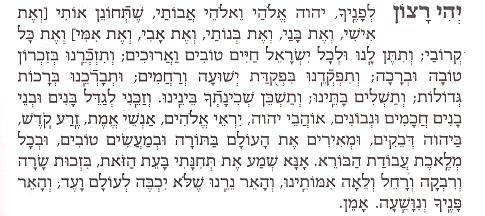
| May it
be Your will HASHEM, my G-d and G-d of my forefathers,
that You show favor to me [my husband, my sons, my daughters,
my father, my mother] and all my relatives; and that You grant
us and all Israel a good and long life; that You remember
us with a beneficent memory and blessing; that You consider
us with a consideration of salvation and compassion; that
You bless us with great blessings; that You make our households
complete; that You cause Your Presence to dwell among us.
Privilege me to raise children and grandchildren who are wise
and understanding, who love HASHEM and fear G-d, people
of truth, holy offspring, attached to HASHEM, who illuminate
the world with Torah and good deeds and with every
labor in the service of the Creator. Please, hear my supplication
at this time, in the merit of Sarah, Rebecca, Rachel, and
Leah, our mothers, and cause our light to illuminate that
it be not extinguished forever, and let Your countenance shine
so that we are saved. Amen. |
|
|
The kindling of Shabbat
lights with a bracha designates the beginning of Shabbat
(for the person lighting the candles). Of course, by nightfall,
Shabbat will have arrived, in any case, for it does not
depend on the actions of Man.
For a streaming video demonstration
of how to light Shabbat candles (using the Ashkenazic/European
Hebrew pronunciation) click
here.
|
|
|
| back
to top
next topic
|
RETURN
TO MAIN SHABBAT PAGE |
|
|
|
SHABBAT
MEALS
3
Meals
Shabbat
- The Ingredient
Lechem
Mishneh

Divrei
Torah
Zemirot
|
"A
semblance of the World-to-Come is the Day of Shabbat."
(Shabbat Zemirot)
|
|
The Shabbat
Meals
On Shabbat we have Shalosh
Seudot - three meals:
- The opening Friday night
dinner after the Synagogue service,
- The Shabbat noonday
meal, and
- Seudat Shlishit -
the third meal, generally a light repast served after Mincha
services and before sundown.
The Talmud (Shabbat
117b-118a) relates this to the pasuk in Shmot, Parshat
Beshalach, (16:25):
"Moshe said, "Eat it (the Manna) today, for today is
a Shabbat for HASHEM; today you shall not find it
in the field."
The threefold use of the word HAYOM (today) in reference
to eating the Manna is the basis for the rule requiring three
meals on Shabbat. One possible explanation
for the frequency and amount of food eaten on Shabbat is
that on Shabbat every Jew gets a 'neshamah yetairah'
- an extra soul that descends from heaven. This soul needs feeding
too. Just kidding.
The traditional Friday evening Shabbat meal includes some
kind of fish, soup and chicken or meat. The custom to eat fish
is to remind us of the mercies of Hashem. Fish have no
eyelids, so that their eyes are never closed; so too are the eyes
of Hashem open at all times to watch over those who fear
Him. The traditional gefilte fish does not require that
bones be removed, a form of separation forbidden on Shabbat.
Some have a custom to eat some
kind of kugel ([usually noodle or potato] pudding) on Shabbat.
Shabbat
- the Ingredient
A story about the special quality
of Shabbat foods, from the Talmud, Tractate Shabbat
119a:
Caesar once said to R' Yehoshua
ben Chananya:
"Why is it that the food cooked for the Shabbat has
such a penetrating aroma?"
[R' Yehoshua] answered him:
"We have this one spice, it is called Shabbat, which
we throw into [the Shabbat food], and its aroma is very
penetrating."
[Caesar] said to him:
"Give us some of it."
[R' Yehoshua] said to him;
"Whoever observes the Shabbat, for him [the spice]
is effective; but for one who does not observes the Shabbat,
it is not effective."
Another story from the Midrash:
R' Yehudah HaNassi (Rabbi Judah the Prince) prepared a
meal for the Roman King Antonius. It was on a Shabbat and
R' Yehudah served him cold foods. A few days later, the
rabbi prepared another meal for the king. This time the meal took
place on a weekday and hot dishes were served.
The Roman king was satisfied with both meals, but he had liked
the Shabbat meal better. He said to the rabbi:
"You served both a cold and a hot meal, but strangely enough
I like the cold dishes much better."
"I am not at all surprised at this," answered the rabbi.
"The cold dishes contained an ingredient which the hot dishes
did not."
"Why did you not put this ingredient also into the hot dishes?"
Antonius asked. "Even if it is very expensive, you should
have bought it for me. I would have gladly refunded you the money."
The rabbi replied:
"The ingredient I refer to cannot be bought on weekdays.
Its name is Shabbat. Shabbat adds an extra flavor to all
dishes, and so they taste much better than on weekdays."
Lechem
Mishneh - Two Challot
The Blessing of HaMotzi
over two Loaves of Bread - Lechem Mishneh
The grandeur and finery at
the Shabbat table makes it clearly distinguishable from
any weekday setting. Its crowning glory is the Lechem Mishneh
- two braided challot covered with a beautiful cloth. This
centerpiece sets the Shabbat (and Yom Tov) seudot
(meals) apart from other dining experiences.
The tradition of "Lechem
Mishneh" has its roots In Shmot / Exodus, Parshat
Beshalach, (16:4) where the Torah relates how Hashem
provided the Bnei Yisroel (children of Israel) with 'manna'
- 'bread from heaven'. Hashem told Moshe, "I shall
rain down for you bread (food) from heaven; let the people go
out and gather each day's portion on its day, so that I can test
them, (to see) whether they will follow My teaching or not."
For forty years, while the Jews
wandered through the desert, Hashem provided them with
Manna, a miraculous nutritious food that could be prepared to
taste like any food your heart desired. The manna came down each
morning, covered with a layer of dew. The Bnei Yisroel
were commanded to gather only "one omer" (a standard
measure of the time - the volume of about 43 eggs) for each member
of the household. Those who tried to gather more than their share
quickly learned that no matter how much manna a person collected,
when they brought it home it amounted to exactly "one Omer"
per person. You couldn't save it either; any manna left over to
the next day spoiled.
This was fine for weekdays.
But what about Shabbat? The Manna didn't fall on Shabbat.
Every Friday, they received a double portion of manna in honor
of the Shabbat. And it did not spoil overnight.
The two Challot that
we place on the Shabbat table commemorate the double portion
of manna that fell every Erev Shabbat for forty years while
the Jewish people were traveling in the desert. We cover the Challah
to commemorate the layer of dew that covered the manna every morning.
Divrei
Torah (Torah Discussions)
The Talmud Tractate Megillah
12b states, that when Jewish people eat and drink, they begin
with words of Torah and words of praise; Shabbat
meals provide a great opportunity for family and friends to share
Divrei Torah (Torah discussions), usually relating
to the Parsha - the Torah Portion of the Week, which
is read in the Synagogue Shabbat morning. Many children
attending Yeshivot and Jewish Day Schools come home on
Friday with 'Parsha sheets,' usually containing a brief
summary of this Torah portion, and often come with Divrei
Torah and a list of discussion questions parents can review
with their children. Many children are very anxious to show off
their newly acquired knowledge at each Shabbat meal. "Parsha
on Parade," Torahtot's own famous "Weekly
Torah Newsletter for Kids" can also form the basis
for very lively discussion.
Zemirot
(Sabbath Songs)
The words of praise mentioned
in the Talmud are the Zemirot, the Ashkenzic word
for the table hymn sung during or directly after the Shabbat
meals. Sefer Chasidim considers the singing of zemirot
as a mitzvah. Zemirot which date from as far back
as the 10th Century have achieved prominence and are printed in
most siddurs, composed by great Torah scholars and Kabbalists.
Their melody fills the air with delight, and their lofty poetry
lifts our hearts in praise of Hashem for giving us the
treasured gift: Shabbat! Many also sing modern Israeli
or Hebrew songs.
At the end of the meal, as
required after every meal (not just on Shabbat), where
bread is eaten, the Birchat Hamazon, Grace after Meals,
is recited. We add two special prayers - "R'tzei V'Hachalitzeinu"
& "Harachaman."
|
|
|
| back
to top
next topic
|
RETURN
TO MAIN SHABBAT PAGE |
|
|
|
FRIDAY
NIGHT
Prayers
Sholom
Aleichem
Aishet
Chayil
Blessing
the Children
Kiddush
Netilat
Yadayim
HaMotzi
|
Prayers
(Kaballat Shabbat - Welcoming the Shabbat and Maariv-
the Evening Service).
Kaballat Shabbat
- The introductory portion of the Friday evening services welcoming
the Shabbat, includes Psalms, readings and songs, the most
famous is the ...
Lecha Dodi -
Come my Beloved
The popular mystical song to the
Shabbat was composed by the sixteenth century kabbalist
Rabbi Shlomo Halevi Alkabetz (c. 5260--5340 / 1500--1580
CE), teacher and brother-in-law of the famed kabbalist Rabbi
Moshe Codovero.
He based the song;
"Lecha Dodi Likrat Kallah,
- Come, my beloved, to meet the [Sabbath] bride,
Penei Shabbat Nekabla,
- The face of the Shabbat Queen we will receive."
on the description in the Talmud, (Shabbat 119a)
of the Sages joyous greeting of the Shabbat:
"Rabbi Chanina would wrap himself in his cloak and say,
“Come, let us go and greet the Shabbat Queen.” Rabbi
Yannai would don his robe and say, “Enter O bride! Enter,
O bride!”
The holy Ari Z'l included this hymn in his edition
of the siddur, and thus it eventually became an integral
part of the Shabbat liturgy of Jewish communities everywhere.
Sholom
Aleichem
This song of praise, sung on
Friday evening is based on the Talmudic passage (Shabbat
119b) which teaches that a good angel and an evil angel accompany
every man home from the synagogue on Friday evening. If they find
the house in good order with the Shabbat table set festively
bedecked with glowing candles and the family dressed in their
best, the good angel says, "May the next Shabbat be
as this one," and the evil angel must respond, "Amen,
may it be so." If on the other hand, they find the reverse,
the house is not fit for the welcoming of royalty (the Shabbat
Queen), the evil angel says "May the next Shabbat
be as this one," and the good angel must unfortunately answer,
"Amen."
It is only proper to greet
the two angels, bless them, and seek their blessing.
Aishet
Chayil
From "A Taste of Judaism - From
A to Z"
Aishet Chayil
(Al. Eishet, Eshet)
(Lit. 'The Woman of Valour.
An Accomplished woman').
Song/Poem written by Shlomo Hamelech (King Solomon). The
poem has an acrostic arrangement in which the verses begin with
the letters of the Hebrew alphabet in regular order. Traditionally
sung Friday night, between "Shalom Aleichem"
and the Blessing of the Children prior to the Shabbat meal.
Aishet Chayil consists of the concluding twenty-two verses
of Mishlei / Proverbs (31:10-31), which, on the surface,
is a hymn to the perfect wife who is the mainstay of her home.
She is trusted by her husband, obeyed by her servants, and admired
by her people. She is kind to the poor and gentle to all. She
is self-respecting and dignified. Husband and children praise
her as the source of their happiness. Her goal in life is to foster
the growth of Torah knowledge and good deeds in her husband
and children---her ultimate accomplishment.
Rab' Yitzchak ben Nechemiah
says in Yalkut Mishlei: "Just as Hashem gave
the Torah to Israel by means of the 22 letters of the Alef-Bet,
so He praises the righteous woman by means of the 22 letters."
Although the Commentators agree
that the chapter is allegorical - it is variously interpreted:
as a reference to the Shechinah, (divine
presence), the Sabbath, the Torah, wisdom,
and the soul. The very fact that the Jewish woman was chosen as
the vehicle through which to describe such lofty spiritual manifestations
is in itself a profound tribute to her.
Blessing
the Children
The beginning of Shabbat is a particularly appropriate
time to bless the children. It is customary to bless children
of all ages, either in the synagogue after services or on returning
home before Kiddush. Both hands are laid on the head of
the child to symbolize a blessing imparted with complete generosity
of spirit.
|
For
a boy:
May G-d make you like Efraim and Menashe.
|
 |
|
For
a girl:
May G-d make you like Sarah, Rivka, Rachel, and Leah.
|
 |
|
For
both:
May Hashem bless you and protect you. May Hashem
cause His face to shine upon you and be gracious to you.
May Hashem raise His face to you and establish peace
for you.
|
|
|
|
|
Kiddush
To sanctify the Shabbat,
Friday evening's dinner and Shabbat lunch begin with Kiddush,
a testament to Hashem's creation of the world. Kiddush
is recited over wine (or grape juice) because wine "gladdens
a man's heart" (Psalms 104:15) and wine is the substance
designated for singing the praises of Hashem (Talmud, Tractate
Brachot 35a).
Some Laws of Kiddush
1. The goblet should be beautiful,
usually a silver cup reserved for this purpose, which holds at
least 4 1/2 liquid ounces. It should be filled to the rim.
2. The wine should be of good quality.
3. We stand during the Kiddush of Friday night (at least
during Vayechulu), because the Friday night Kiddush
testifies that Hashem, the Creator of the world, rested
on the seventh day, declared it holy, and gave us, the Jewish
people, this gift, this holy day to observe.
4. When there is no wine, the Friday night kiddush may
be recited on the Challah.
5. Women, too, are obliged to hear Kiddush.
6. The Challah should be covered during Kiddush..
Friday
Night Kiddush
Va-ye-hi
Erev Va-ye-hi Boker
Yom Ha-shi-shi. Va-y'chu-lu Ha-sha-ma-yim v'ha-a-retz,
v'chawl ts'va-am. va-y'chal e-lo-him ba-yom ha-sh'vi-i,
m'lach-to a-sher a-sa va-yish-bot ba-yom ha-sh'vi-i, mi-kawl
m'lach-to a-sher a-sa. va-y'va-rech e-lo-him et yom ha-sh'vi-i,
va-y'ka-deish o-to ki vo sha-vat mi-kawl m'lach-to a-sher
ba-ra e-lo-him la-a-sot.
Sav-rei
ma-ra-nan ve-ra-banan ve-ra-bo-tai!
Ba-ruch
a-tah, A-do-nai, Eh-lo-hei-nu me-lech ha-o-lam, bo-rei
p'ri ha-ga-fen. (All
present respond: Amen.)
Ba-ruch
a-tah, A-do-nai, Eh-lo-hei-nu, me-lech ha-o-lam, a-sher
ki-d'sha-nu b'mits-vo-tav v'ra-tsa va-nu, v'sha-bat kawd'sho
b'a-ha-va uv'ra-tson hin-hi-la-nu, zi-ka-ron l'ma-a-sei
v'rei-shit. ki hu yom t'chi-la l'mik-ra-ei ko-desh, ze-cher
li-tsi-at Mits-ra-yim. Ki va-nu va-char-ta v'o-ta-nu ki-dash-ta
mi-kawl ha-a-mim, v'Shabbat kawd-sh'cha b'a-ha-va u-v'ra-tson
hin-chal-ta-nu. Ba-ruch a-tah A-do-nai, m'ka-deish ha-Shabbat.
(All present
respond: Amen.)
|
And
there was evening and there was morning..
The sixth day. Thus the heavens and earth were finished,
and all their array. On the seventh day G-d completed
His work which He had done, and He abstained on the seventh
day from all His work which He had done. G-d blessed the
seventh day and made it holy, because on it He abstained
from all His work which G-d created to make.
By
your leave, my masters, rabbis and teachers!
Blessed
are You, HASHEM, our G-d, King of the universe,
Who creates the fruit of the vine. (All
present respond - Amen)
Blessed
are You, HASHEM, our G-d, King of the universe, Who has
sanctified us with His commandments, took pleasure in
us, and with love and favor gave us His holy Shabbat
as a heritage, a remembrance of creation. For that day
is the prologue to the holy convocations, a memorial of
the Exodus from Egypt. For us did You choose and us did
you sanctify from all the nations, and Your holy Shabbat,
with love and favor did You give us as a heritage. Blessed
are You, HASHEM, Who sanctifies the Shabbat. (All
present respond - Amen)
|
|
|
|
FOR
A PRINT COPY CLICK
HERE
|
The one reciting the Kiddush
drinks at least three ounces, and then distributes the rest into
smaller cups to those at the table.
Netilat
Yadayim - Washing the Hands
Following Kiddush, everyone
washes their hands in the prescribed ritual manner* to prepare
for eating bread, and recites the appropriate bracha /
blessing.
*(Fill a large cup that holds at least four and a half ounces
with water and pour water on each hand front and back, starting
with the right hand. Many people use special Handwashing Cups,
which have two handles to them to make the pouring of the water
easier).
| Baruch A-tah A-do-nai,
Eh-lo-hay-nu Me-lech Ha-olam, Asher Ki'-de-sha-nu B'-mitz-vo-tov,
V' tzi-vanu al N'tee-lat Ya-da-yim. |
| Blessed are You, HASHEM
our G-d, King of the universe, Who has sanctified us with
His commandments, and has commanded us regarding washing the
hands. |
 |
|
|
Once you make this bracha,
you may not speak until you eat your first piece of Challah.
Hamotzi
Before saying the bracha
"Hamotzi" over the two
Challot, the head of the household lightly draws
the knife across the Challah making a slight indentation
in the Challah to indicate the place for cutting, then
raises the Challot to recite the bracha. At the
end of the bracha, everyone responds "Amen."
| Baruch A-tah A-do-nai,
Ehlo-hay-nu Me-lech Ha-olam, Ha-motzi Leh-chem Min Ha-aretz.
(All present respond - Amen) |
| Blessed are
You, HASHEM our G-d, King of the universe, Who brings forth
bread from the earth. (All present respond
- Amen) |
|
|
|
|
The head of the household cuts
a piece of Challah for himself, and dips it in salt* and
eats it so that there is no unnecessary lapse of time between
the blessing and the act of eating. He then cuts and distributes
the rest of the Challah to those around the table.
*(as a commemeration of the sacrifices which were salted when
offered up on the Mizbayach / altar in the time of the
Beit Hamikdash).
Enjoy the Friday night meal.
|
|
|
| back
to top
next topic
|
RETURN
TO MAIN SHABBAT PAGE |
|
|
|
THE
SHABBAT DAY
|
Shabbat
as a "special spice" for the Shabbat meals:
Shabbat
119a
|
Prayers
Meal
II
Kiddush
|
THE SHABBAT
DAY
Shacharit
Prayers
It is customary to begin the
morning service on Shabbat later than on the weekdays.
The reason for this custom is found in Bamidbar Parshat Pinchas.
The morning service is in place of the morning sacrifice. When
speaking about the daily morning sacrifice in this Parsha,
the Torah uses the expression "in the morning"
(28:4). But when mentioning the Shabbat sacrifice the expression
is, "On the Shabbat day" (28:9) which implies
a later time than morning.
The Shabbat Morning services
usually take more time than the weekday morning services. Here's
why.
1. The Sh'liach Tzibur (leader of the prayer
service) takes his time singing the prayer melodies on
Shabbat.
2. After Shacharit, we have Kriat HaTorah - Reading
of the Parshat Hashavua, Torah portion of the Week.
3. After the Parsha is read we read the Haftorah -
a selection chosen from Nevi'im / Prophets that usually
relates to the Torah portion read that day.
4. Finally, we have the Musaf prayer - in commemoration
of the Musaf (additional) sacrifices in the Beit HaMikdash.
The
Shabbat Meals - Part II
Kiddush
The Shabbat noon day
meal begins with Kiddush. The daytime Kiddush is
of later origin, established by the Sages, and is of less prominence
than the Kiddush of Friday night. It is also shorter -
just one Bracha (blessing), which led the Talmud -
(Tractate Pesachim 106a), in irony, to call it "Kiddusha
Rabbah - Great Kiddush."
To add prominence to the morning Kiddush, there is
a custom of including additional Torah verses. There are
various customs as to which p'sukim [verses] are recited
with the morning Kiddush. Some begin at "Al Kain
Beirach - Therefore He Blessed" [which may be problematic
because it begins in the middle of a verse (Shmot
/ Exodus 20:11)]. Some begin with "Im Tashiv
- If you restrain..." (Yeshayahu /
Isaiah 58:13-14). Others begin with the verse, "V'Shamru
Vnei Yisrael et ha-shabbat, - The Children of Israel shall
observe the Shabbat..." (Shmot
/ Exodus 31:16-17).
Still others begin with "Zachor et Yom HaShabbat
L'kadsho - Remember the Sabbath Day to keep it holy."
(Shmot /
Exodus 20:8-11).
|
Many omit some or all
of these verses and begin with 'Al
kein bei-rach '
IM
TASHIV
Im
ta-shiv mi'Shabbat Rahg-leh-cha ah-sot cha-fah-tzecha
b'yom kodshi v'ka-rata la-shabbat oh-neg lik-dohsh HASHEM
m'chu-bawd v'chi-bah-deto me'asot d'rah-cheh-cha mim-tzo
chef-tzecha v'dah-bair da-var. Az tit'ah-nag al-HASHEM v'hir-kav-ti-cha
al-ba-ma-tei ah-retz v'ha'ah-chal-ti-cha nah-cha-lat Ya-ah-kov
ah-vi-cha ki pi HASHEM dee-ber.
V'SHAMRU
Ve-shamru
v'nei Yisroel et ha-Shabbat, la'asot et ha-Shabbat le-doro'tam
brit olam. Bei-ni u-vein b'nei Yisroel ot hi le-olam, ki
shei-shet ya-mim ah-sah A-do-nai, et ha-sha-mayim ve-et
ha-aretz uva-yom ha-shevi'i shavat va-yi-nafash.
ZACHOR
Zachor
et yom ha-Shabbat le-kade-sho. Shei-shet ya-mim ta'avod
ve-asisa kol melachtecha. Ve-yom ha-shevi'i Shabbat LA-do-nai,
Elo-hecha, lo ta'aseh chol melachah ata u-vin-cha u-vi-techa
av-decha va-amat'cha uv-hem'techa ve-geir-cha asher bi-she'arecha.
Ki sheishet ya-mim ah-sah A-do-nai et ha-sha-mayim ve-et
ha-aretz et ha-yam ve-et kol ah-sher bam, va-ya-nach ba-yom
ha-shevi'i -
Al kein bei-rach A-don-ai et
yom ha-Shabbat va-ye-kad-shei-hu.
THE
BRACHA OVER WINE
Sav-rei
ma-ra-nan ve-ra-banan ve-ra-bo-tai!
Ba-ruch
a-tah, A-do-nai, Eh-lo-hei-nu me-lech ha-o-lam, bo-rei p'ri
ha-ga-fen. (All
present respond: Amen.)
|
|
Many omit some or all
of these verses and begin with 'therefore
HASHEM blessed.'
IM
TASHIV
If you restrain, because
of the Sabbath, your feet, refrain from accomplishing your
own needs on My holy day; if you proclaim the Sabbath 'a
delight,' the holy one of HASHEM, 'honored one, and
you honor it by not doing your own ways, from seeking your
needs or discussing the forbidden. Then you shall be granted
pleasure with HASHEM and I shall mount you astride
the heights of the world, and provide you the heritage of
your forefather Jacob - for the mouth of HASHEM has
spoken.' (Yeshayahu / Isaiah 58:13-14).
V'SHAMRU
And the Children of Israel
observed the Sabbath, to make the Sabbath for their generations
an eternal covenant. Between Me and the Children of Israel
it is a sign forever, that in six days did HASHEM
make the heaven and the earth, and on the seventh day He
rested and was refreshed.'
(Shmot / Exodus 31:16-17).
ZACHOR
Always remember the Sabbath
day to hallow it. For six days you may labor and do all
your work. But the seventh day is the Sabbath for HASHEM,
Your God; you may do no work - you, your son and your daughter,
your slave and your maidservant, your animal, and the stranger
who is in your gates. For in six days did HASHEM
make the heaven and the earth, the sea and all that is in
them and He rested on the seventh day;
therefore
HASHEM blessed
the Sabbath day and sanctified it.
(Shmot / Exodus 20:8-11).
THE
BRACHA OVER WINE
By your leave, my masters
and teachers:
Blessed are You, HASHEM,
our G-d, King of the universe, Who creates the fruit of
the vine. (All present respond - Amen.)
|
 |
|
|
The one reciting the Kiddush
drinks at least three ounces, and then distributes the rest into
smaller cups to those at the table.
Following Kiddush, everyone
washes their hands in the prescribed ritual manner* to prepare
for eating bread, and recites the appropriate bracha /
blessing.
*See above for Some Laws of
Kiddush. Netilat
Yadayim, Hamotzi and Lechem
Mishneh.
The noon day meal is highlighted
by Cholent, a hearty dish usually composed of beans, barley,
potatoes and meat. True to its etymological origins, the French
words chaud (hot) and lent (slow), Cholent simmers all
night and makes a hearty meal at Shabbat lunch. One of
the reasons for Cholent is to remember the Manna which,
in honor of Shabbat, remained fresh and delicious from
Friday through Shabbat, so too the Cholent is placed
on a Shabbat hot plate (blech) or slow cooker (crock pot)
before Shabbat in order to stay hot and delicious for the
Shabbat afternoon meal.
Divrei Torah
(Torah Discussions)
Again, the Shabbat meal
provides a great opportunity for family and friends to share Divrei
Torah (Torah discussions).
Zemirot
(Sabbath Songs)
For Shabbat Afternoon,
some Zemirot which date from the date from as far back
as the 10th Century have achieved prominence and are printed in
most siddurs, composed by great Torah scholars and Kabbalists.
At the end of the meal, as
required after every meal (not just on Shabbat), where
bread is eaten, the Birchat Hamazon, Grace after Meals,
is recited. We add two special prayers - "R'tzei V'Hachalitzeinu"
& "Harachaman."
V'shinantom
Levonecho -Torah Learning
One of the benefits of Shabbat
is that it affords us the opportunity to learn Torah, and
to share that learning with others. Shabbat is the appropriate
time to devote to Torah study especially with the children.
Shabbat
Walk
Shabbat afternoon is the perfect
time for families to take a walk, visit and spend time with relatives
and/or friends.
Sleeping
"Sheina B'Shabbat Taanug - Sleeping on Shabbat
is regarded as a special pleasure - (from the Piyut 'Mah Yedidut') - also the acronym to the letters of Shabbat. (See Yalkut Ruveini, Va'etchanan).
Taking extra-long naps and super-extended
beauty sleeps also discharge one of the duty to "rest."
We recite many blessings on
Shabbat in order to complete the daily requirememnt of
100 brachot.
|
|
|
| back
to top
next topic
|
RETURN
TO MAIN SHABBAT PAGE |
|
|
|
SEUDAH SHLISHIT |
MINCHA
& SEUDAH SHLISHIT
The word Mincha means
rest and at this point of the day, we are rested (hopefully),
then the mood shifts to be more quiet and even a little pensive,
acknowledging that the Shabbat is coming to an end.
Shabbat Mincha includes
some opening prayers (beginning with Ashrei), a short Torah
reading* with only three aliyot, followed by a recitation
of the Amidah and the closing prayers. We concluded the
weekly Torah reading on Shabbat morning, and now
begin the new week's Torah reading at the Mincha
service, so that there is a "changing of the guard"
as far as the Parshat Hashavuah (weekly portion) is concerned.
[*Ezra
established that three people be called to the Torah at
every Shabbat Mincha service, to read at least ten verses
from the Torah portion to be read during the coming week.
This is so that people who work throughout the week, and do not
hear the Torah reading of Mondays and Thursdays, will have
an added opportunity on Shabbat to hear the Torah
read. Even if a holiday falls on Shabbat, the portion for
the coming week is read and NOT the portion that is read on the
holiday. This is because there is no correlation between the Mincha
Torah reading and the holiday - if it wouldn't be also Shabbat,
they would not read from the Torah during Mincha
at all. ]
Seudah Shlishit or the
third meal, follows the Minchah (afternoon) service. Some
may choose to eat this meal at home, but most synagogues serve
a meal minimally consisting of bread rolls. This provides members
with good conversation, (if not good
food), another opportunity to listen to interesting Divrei
Torah, and to sing more Shabbat zemirot. Mizmor
L'David is traditional for this meal; some say/sing it three
times. Y'did Nefesh is also a traditional Seudah Shlishit
song.
As
with the other 2 Shabbat meals, Lechem
Mishneh is a requirement. After the meal, as required
after every meal (not just on Shabbat), where bread is
eaten, the Birchat Hamazon, Grace after Meals, is recited.
We add two special prayers - "R'tzei V'Hachalitzeinu"
& "Harachaman." Regardless of how far
into the night one's Seudah Shlishit has been extended,
"R'tzei"
is recited unless one davened Maariv before bentching.
The Talmud says
that the person who fulfills the obligation of eating three meals
on Shabbat will merit a "good judgment" in the
World to Come, for he has shown good judgment in not overeating
during the first two Shabbat meals, so he could fulfill
the mitzvah of eating a third meal, in honor of the holy
day.
During the first
two meals of the day we are actually hungry and eat with particular
enjoyment. By the time of the third meal we may no longer be hungry,
but we sit down to partake with song and rejoicing in order to
fulfill Hashem's commandment that we eat at least three
meals on Shabbat. It is not the food which draws us to
the table, but the desire to carry out His precepts.
Women are obligated
to eat Shalosh Seudot too. Women were equal beneficiaries
of the miracle of the Manna, the source/reason for Shalosh
Seudot (3 meals). (Mishna Berura).
|
|
|
| back
to top
next topic
|
RETURN
TO MAIN SHABBAT PAGE |
|
|
|
HAVDALAH
MELAVE
MALKA
|
HAVDALAH
We conclude Shabbat
with Havdalah. Its fragrant spices cheer us as our neshamah
yetairah departs, and its candle burns brightly with the promise
and potential of the week ahead.
(From A Taste
of Judaism - From A to Z)
HAVDALAH (Heb: 'distinction
or separation')
The Havdalah service, attributed to the men of the Great
Assembly, (Talmud Berachot 33a), formally marks the end
of Shabbat, affirming the distinction between the Sabbath
and the other days of the week, between the sacred and the secular.
Havdalah should be
performed no earlier than nightfall on Saturday night. Nightfall
is the time when three stars can be seen in the sky. It is normally
about 45 minutes to an hour after sundown, depending on your latitude.
For the precise time when Shabbat ends in your area, consult
the list of candle lighting times here
or those provided by the Orthodox
Union.
The Havdalah service
uses wine, spices and candles. The wine for the Havdalah
is allowed to flow over as a symbol of the overflowing blessing
expected in the coming week.
The Havdalah service
consists of four brachot:
The first blessing is over
wine to mark the distinction between the sacred and the profane
and the difference between the Shabbat and the weekdays.
The second is a blessing over
spices. In a sense, this is the last blessing of Shabbat.
This is the only place in Judaism when aromatics are used ritually.
Abudraham writes that we receive a second soul (neshamah
yetairah) on Shabbat, which gives a person heightened
spiritual sensitivity. When Shabbat ends, this soul departs.
Smelling the pleasant odor of fragrant spices eases the loss of
the departing additional Shabbat soul. Smelling the spices
also signifies the hope for a fragrant week. When a Yom Tov
directly follows Shabbat the spices are omitted, because
the soul then rejoices with the incoming festival. Any aromatic
mixture may be used. A common Ashkenazic custom is to use
cloves, bay leaves or other pickling spices. Sephardic
communities use rosewater, myrtle, lemon or mint, and the precise
wording of the Sephardic Havdalah depends on whether it
comes from a tree, from an herb, or neither. The Zohar
specifies myrtle. Spices are usually held in a spice box, and
artists have created a marvelous variety of these.
The third blessing is over
the light of the Havdalah candle flame, which is lit just
before the service starts. The light signifies the hope for a
week of brightness and joy. A twisted candle of several wicks
is used, because the phrase "Meoray Ha'aish - the illuminations
of the fire" is in the plural. (If such a candle is unavailable,
two candles with flames touching may be used).
The Talmud (Pesachim
54a) gives the reason for the institution of this blessing. Fire
was created at the end of Adam's first Shabbat on earth.
Then, G-d gave Adam the instinctive understanding to rub stones
together in order to bring forth a fire for light and heat. Midrash
Rabbah (11:2) elaborates that HASHEM did so in response
to Adam's fear when he saw darkness falling. He was terrified
lest, having been banished from the Garden of Eden, he would be
faced with mortal danger that he could not even see. Therefore,
we recite the blessing over fire, because it was at the end of
Shabbat that it was created.
As in the case of all such
blessings, we do not recite a blessing over something that we
do not use or enjoy, in this case, the illumination of the fire.
Therefore, we cup the hands around the Havdalah candle
as we hold our fingers up to the flame -- seeing the reflection
of the flame on our fingernails, or the shadow on the palm of
the hand, thus indicating the distinction "between light and darkness."
Lastly, there is a blessing
of HASHEM, who makes distinctions, who separates the day
of rest from the six days of work, who separates the holy from
the ordinary. If a Yom Tov directly follows Shabbat
the wording is changed slightly, since a Yom Tov is not
"ordinary."
The custom of dipping the finger
in the wine (plate) of the Havdalah and passing it over
the eyes alludes to Tehillim / Psalms 19:9, where HASHEM's
commands are described as "enlightening the eyes." It is customary
in some communities to dip fingers in the wine and then to put
them in one's pockets as well. These usages are not applicable
whenever the Havdalah is recited as part of the Kiddush
for Yom Tov.
In Talmudic literature, great
importance is attached to Havdalah: future salvation as
well as material blessings are promised to those who recite the
Havdalah over the wine cup: "He who resides in Eretz
Yisroel / Israel, he who teaches his children Torah,
and he who recites the Havdalah at the conclusion of the
Sabbath will enter Olam Haba (The World to Come) (Pesachim
113a).
MELAVE
MALKA
(From A Taste of Judaism - From A to Z)
MELAVE MALKA (Lit. 'Accompanying
the Queen').
On Saturday evening, after Shabbat, following Havdalah,
a farewell banquet is prepared for a most important guest, the
Shabbat Queen.
Just as one must honor Shabbat at its entry, so must one
honor it at its departure. This is done by partaking of a post-Shabbat
meal, called Melave Malka. This custom originated with
David HaMelech (King David), who knew he was destined to
die on Shabbat. After every Shabbat, he celebrated
his survival with an elaborate feast. Some people begin their
Melave Malka by lighting candles, in the hope that the
spirit of Shabbat will linger in their homes all week.
Everyone is obligated to eat Melave Malka. Women, and children
old enough to be trained in mitzvot, are also included
in this obligation. It should be eaten at a nicely set table.
It is also proper not to remove one's Shabbat clothes until
after the Melave Malka.
The Seudat Melave Malka should preferably be eaten soon
after Shabbat is over and before the end of four hours
into the night. If one does not have an appetite for eating the
meal right away, it would be proper not to do any work until after
the Melave Malka, except for food preparation. It should
not be delayed past Chatzot (midnight).
Ideally, one should eat bread and meat (or some other cooked food)
like the other meals of Shabbat. If that is difficult for
a person to eat, one should eat cake or some other mezonot,
or at least some fruit. (There is an opinion that if one cannot
even eat fruit, one may fulfill their obligation by drinking coffee
or tea.)
Even if one is full from the Shabbat meals, one should
push themselves to fulfill the Mitzvah of Seudat Melave
Malka.
The Seudat Melave Malka is not necessary on Motzo'ei
Yom Tov. However, some people are accustomed to eat this meal
even on Motzo'ei Yom Tov. One may not eat meat for Melave
Malka on Motzo'ei Shabbat Chazon.
|
|
|
| back
to top
next topic
|
RETURN
TO MAIN SHABBAT PAGE |
|
|
|
SPECIAL
SHABBATOT
|
- Some Sabbaths have a special
name and special significance. Some of them have a special Maftir
(additional Torah readings) read in the Synagogue after
the regular Torah readings replacing the regular Shabbat
Maftir readings, while others do not.
- Shabbat
Bereishit
- The first Shabbat
after Simchat Torah on which the Parsha of Bereishit
is read.
-
- Shabbat Chazon
- (Lit. 'Shabbat of Vision');
The Shabbat before Tisha B'Av - the Ninth of Av,
is called the 'Shabbat of Vision,' because of the Haftorah
which is read from the first chapter of the Book of Yeshayahu
/ Isaiah: (1:1-27), which begins "Chazon Yeshayahu
- (the vision of Yeshayahu...)". In it, he prophesies
about the destruction of Yerushalayim and the Beit
Hamikdash.
-
- Shabbat HaChodesh
- The Shabbat preceding
Rosh Chodesh Nisan, or when Rosh Chodesh Nisan
falls on Shabbat, the Shabbat of Rosh Chodesh
Nisan, is called Shabbat HaChodesh. The Maftir,
from Shmot / Exodus, Parshat Bo, (12:1-20), starts
with the first Mitzva given to the Bnei Yisroel,
while they were still in Mitzrayim, even before the Mitzvot
of the Yom Tov Pesach (Passover festival) - the Mitzva
of Kiddush Hachodesh (the sanctification of the new
moon). The reading begins with the declaration that the Hebrew
month of Nisan, and not Tishrei, is to be considered
the first month of the year. The passage then continues with
some of the mitzvot of Pesach
/ Passover, which are certainly appropriate to be read and
studied as the holiday approaches.
-
- Shabbat Hagadol
- (Lit. 'the Great Shabbat');
The Shabbat preceding Pesach
/ Passover is called Shabbat HaGadol because it was
the day when the Jews were to take the sheep (which the Egyptians
worshipped) to be used for the Korban Pesach (Pascal
offering) four days later. (This means that the first Pesach
was on a Wednesday).
After nine plagues, the Egyptians were powerless to react to
the slaughter of one of their gods. The Israelites, of course,
didn't know this, and therefore displayed tremendous faith in
Hashem prior to Yetziat Mitzrayim (the Exodus).
We remember this event with a special Haftorah where
again great faith and trust in Hashem is emphasized.
The Haftorah concludes with the call to remember the
teachings of Moshe and informs us that Hashem
will send Eliyahu Hanavi (Elijah the Prophet) to herald
the great and awesome day when Bnei Yisroel will again
experience redemption. This is yet another possible reason for
the name Shabbat HaGadol, - that "great day" mentioned
in the Haftorah.
Traditionally on Shabbat HaGadol the Rabbi lectures about
the observance and meaning of Pesach to his congregation,
teaching the laws of Pesach, so that the families can
prepare properly for the Yom Tov. Which leads to another
interpretation of Shabbat HaGadol - "the Shabbat of the
Leader" or of the Rabbi. A more novel explanation is that the
people returning from the synagogue later than usual on this
Shabbat because of the unusually long speech that was
customary on this day. Thus this Shabbat seemed "great,"
i.e., longer than the other Shabbatot.
Whatever the reason for the name, it is customary to recite
part of the Haggadah on Shabbat HaGadol, from
'Avadim Hayinu' "we were slaves in Egypt" to 'Lechaper
Al Kol Avonoteinu.'
-
- Shabbat Mevarchim
- The Shabbat that
precedes Rosh Chodesh, on which the coming new month
is blessed with a special prayer. If Sunday is Rosh Chodesh,
then the regular Shabbat Maftir readings is replaced
with "Mochor Chodesh."
-
- Shabbat Nachamu
- The Shabbat of
consolation or comfort, the Sabbath after Tisha B'Av
- the Ninth of Av. The Shabbat is called Shabbat Nachamu,
for the Haftorah which begins with the words: "Nachamu,
Nachamu Ami - Be comforted, be comforted, my people..."
(Yeshaya / Isaiah 40). In this chapter, the Navi
describes the Ultimate Redemption (Moshiach) which we
have yet to experience. May it be speedily in our days.
-
- Shabbat Parah
- The Shabbat immediately
following Purim is designated as Shabbat Parshat Parah.
The Maftir, from Bamidbar, Parshat Chukat,
(19:1-22), describes the preparation of the Parah Adumah
(Red Heifer), whose ashes were used in the spiritual purification
process during the time of the Beit Hamikdash. This purification
was carried out at this time of the year to ensure that everyone
would be able to partake in the Korban Pesach (Pascal
Lamb) to be offered on the 14th day of Nisan.
-
-
- Shabbat Shekalim
- The Shabbat preceding
Rosh Chodesh Adar (or Adar II in a leap year) is called
Shabbat Parshat Shekalim. If Rosh Chodesh falls
on Shabbat itself, then that Shabbat is Parshat
Shekalim. The Maftir, from Shmot, Parshat Ki Sisa,
(30:11-16), describes the census or counting of every Jew and
the obligation to give a Half-Shekel
terumah (contribution) during the month of Adar to pay for
the public Korbanot (sacrifices) in the Beit Hamikdash
in Yerushalayim.
-
- Shabbat Shirah
- Lit. Shabbat of
Song;
The Shabbat on which Parshat Beshalach (Shmot
/ Exodus) is read is called Shabbat Shirah, because it
contains the song, Az Yashir, (ibid 15:1-18), sung
by the Bnei Yisroel after the splitting of the Red Sea.
-
- Shabbat Shuvah
- (Lit. 'Shabbat of Return';)
The Shabbat between Rosh
Hashana and Yom
Kippur is called Shabbat Shuva because the Haftorah which
is read on this Shabbat begins with the words Shuva
Yisroel, (Repent O' Israel). Others call it Shabbat Teshuva
(Repentance), as it falls in the Aseret Ymay Teshuva,
(Ten Days of Repentance).
It is customary for the Rabbi of the Congregation to give a
sermon on this Shabbat which includes the basic laws
of Yom Kippur and Sukkot, and devoted to the theme
of Teshuva and hopefully awaken and inspire people to
correct their ways with Teshuva.
-
- Shabbat Zachor
- The Shabbat immediately
preceding Purim
is called Shabbat Zachor. The Maftir, from Devarim,
Parshat Ki-Teitze, (25:17-19), deals with the commandment
to "Remember what Amalek did to you on the way, upon your departure
from Mitzrayim (Egypt).... ... how they perpetrated a
cowardly and unprovoked attack... You shall erase the memory
of Amalek from the heavens, you shall not forget."
This commandment, to remember Amalek, is one of the 613 commandments.
It is incumbent, therefore, upon every person to attend services
on Shabbat Zachor in order to hear this special reading
and remember its message.
What is the connection between erasing the memory of Amalek
and Purim? The wicked Haman, who intended to destroy
all the Jews in one day and claim their spoils, was the descendant
of Agag who was the king of Amalek in the time of King Shaul.
Thus we know that Haman was an Amalekite. This is why our sages
ordained carrying out the commandment of remembering to erase
the memory of Amalek before Purim. Zachor means
remember - "Remember... do not forget!"
-
|
|
|
| back
to top
next topic
|
RETURN
TO MAIN SHABBAT PAGE |
|
|
|
GLOSSARY
|
- GLOSSARY of SHABBAT
WORDS
Aishet
Chayil - "The Woman of Valour"-- Written by
King Solomon. Traditionally sung Friday night, between "Shalom
Aleichem" and the Blessing of the Children.
Aliyah
- (pronounced: ah-lee-yah) To be "called up" to the
Torah. Common usage: "I got an aliyah",
or, "This is the last aliyah". (Also refers
to the act of moving to Israel..."Our neighbors have decided
to make aliyah").
Amidah
- (also called Shmoneh Esrei)-- The silent prayer said
at home or in shul. (see Shul)
Bentching
- Yiddish, meaning "blessings". The Grace After
Meals-- recited at the conclusion of the three meals, if one
"washed" and ate bread. Common usage: "Let's
bentch", or, "I already bentched",
(see Birchat HaMazon).
Birchat HaMazon
- Bentching See Above. Grace after meals.
Blech -
The covering for your stove top, usually made of sheetmetal.
Bracha
- Blessing. Common usage: "It's time for the children's
bracha", or, "No rain on Shabbat is a real
bracha".
Challah
- Bread traditionally used on Shabbat, often braided.
Can be white, whole-wheat, sweet, "water", or egg.
Originally referred to the taking of a piece of dough....
Cholent
- A Shabbat stew, consisting often of stew meat, potatoes,
beans and barley, usually served for lunch Shabbat day,
after shul.
Davening
- Prayer service, or, praying. Common usage: "I'm late
for davening", or, "The chazzan davened
nice". Daven - to Pray.
D'var Torah
- "A Word of Torah" (sometimes called a "vort",
Yiddish for a "word"). A short talk or discussion
at the Shabbat table, usually centred around the Torah
Portion of the Week. Common usage: "Shhh... He's giving
a D'var Torah", or, "Do you have a vort?"
Erev -
Eve. Common usage: "I'll drop the flowers off at our hosts
erev Shabbat" - as in the hours just before Shabbat.
"Good
Shabbos" - Traditional Shabbat salutation, said
upon meeting or departing. Can be said as early as Thursday,
meaning, "Hope you have a 'Good Shabbat'".
See also, "Shabbat Shalom".
Note: "Good Shabbos" is really from the Yiddish, "Gut
Shabbos", and uses the Ashkenazi pronunciation, with
the "s" sound at the end of Shabbos. "Shabbat
Shalom" is hebrew, using the Sephardi pronunciation,
with the "t" sound at the end of "Shabbat".
"Gut Vuch"
- (Yiddish) Meaning "Good Week". Said to one
another at the end of Shabbat. See also "Shavuah
Tov".
Hamotzi
- The blessing over the bread.
Havdalah
- The short ceremony done at home that concludes the Shabbat.
Performed with a a cup of wine, a multi-wicked braided candle,
and besomim - sweet smelling spices.
Kiddush
- The blessing that sanctifies Shabbat. Blessing over
the wine at the first meal (Friday Night), in Shul Shabbat
after Mussaf, and/or at home at the second meal (Shabbat
lunch). Friday night's Kiddush recalls Hashem's
resting on Shabbat, and the Jewish people's status as
free individuals who are able to observe this day of rest.
Kippah
- (Yiddish, "Yarmulka")... headcovering for a Jewish
male.
Lechem
Mishneh - "Two Breads"-- the two challahs
used for Hamotzie (see above).
Maariv
- The evening prayer service, said after sundown daily.
Manna -
The food Hashem provided the Jews during the years in
the desert after they were redeemed from Egypt, which tasted
like whatever food they wanted. They were provided with two
portions on Friday so they wouldn't have to gather it on Shabbat.
Matzoh
- Unleavened bread, resembles large crackers.
Mayim Achronim
- Literally, "After Waters"-- the washing of one's
fingertips at the conclusion of the meal, so as to have clean
hands for bentching (see above).
Mazel Tov!
- Congratulations! Literally, "Good Luck!" Common
usage: "Mazel Tov to the _____s on the recent birth
of their baby daughter."
Melava Malkah
- Celebration Saturday night after Shabbat.
Minchah
- The afternoon prayer service.
Minyan
- A quorum of ten adult males needed for prayer. Usage: "We
need a minyan", or, "I'm going to minyan,"
meaning, "I'm going to shul".
Motzei Shabbat
- Saturday night, after Shabbat is over.
Muktzah
- (Lit. 'set apart.') An object forbidden to be used or carried
on the Shabbat and Festivals because of its not being
fit or meant for use on that day. (eg., money, pens, etc...).
One must avoid doing anything on Shabbat that could lead
to work - i.e. carrying money. As a result, anything that can
be used, money, a hammer, etc., also cannot be handled. These
items are referred to as "Muktza."
Musaf -
A late morning service recited on Shabbat, on Holidays, and
on Rosh Chodesh (the first day(s) of the new month).
Parsha
- Torah Portion of the Week.
Sefer -
A book containing words of Torah.
Sefer Torah
- The hand-written scroll containing the Five Books of Moses.
Seuda Shlishit
- The Third Meal of Shabbat, eaten late Saturday
afternoon. (Also called Shalosh Seudos)
Shabbat
- Sephardic pronunciation of the Jewish Sabbath, also called
Shabbos. See Shabbos.
- Shabbat Shalom
- Shabbat greeting, meaning a "Peaceful Sabbath" (see
also "Good Shabbos").
Shabbos
- Ashkenazic pronunciation of the Jewish Sabbath, also called
Shabbat. See Shabbat.
Shabbat Shalom
- A greeting given on Shabbat, meaning - [may you have]
the peace of the Shabbat. Alternatively, Gut Shabbos
in Ashkenazic or Yiddish.
Shabbaton Pl.
Shabbatonim
1. The singular
term 'Shabbaton', is used in the Torah to describe the
Yomim Tovim.
2. Modern day usage (s. & pl.) refers to a special Shabbat
program of study and celebration.
Shacharit
- The morning prayer service.
Shalom
Aleichem - First song at the Friday night meal, welcoming
the visiting "angels." Also a greeting, meaning "Peace
Be With You"...answered with "Aleichem Shalom,"-
"And With You, Peace".
Shalosh
Seudot - The third meal of Shabbat in the late
afternoon. (Also called Seudah Shlishit)
"Shavuah
Tov" - Literally, "Good week"...said to one
another at the end of Shabbat. (Also see "Gut
Vuch")
Shir Hamalot
- The psalm sung before bentching.
"Shkoyach"
- A mashed together version of "Yasher Koach",
(literally, "May Your Strength be Straightened"),
but more effectively translated loosely as "Way to Go",
or "More Power to Ya'" Often said at the conclusion
of the D'var Torah (see above) by those listening.
Shul -
Synagogue-- house of prayer.
Siddur
- Book containing formal prayer service.
- Siyum
- A party held in celebration of the completion of something
(eg/ learning an entire book of the Torah).
Synagogue - (see
Shul)
Tallit -
Prayer shawl.
Torah
- Five Books of Moses. (also see Sefer Torah)
"Washing"
- "We're washing", "Let's Wash", or, "Did
you wash for bread?"-- meaning the ritual cleansing of
hands before the blessing over bread. Usually performed with
a two-handled washing cup, pouring water over each hand, followed
by a blessing.
Yarmulka
- (see Kippah)
Zmirot--
Shabbat songs. (see Zemirot )
|
|
|
| back
to top |
RETURN
TO MAIN SHABBAT PAGE |
|


